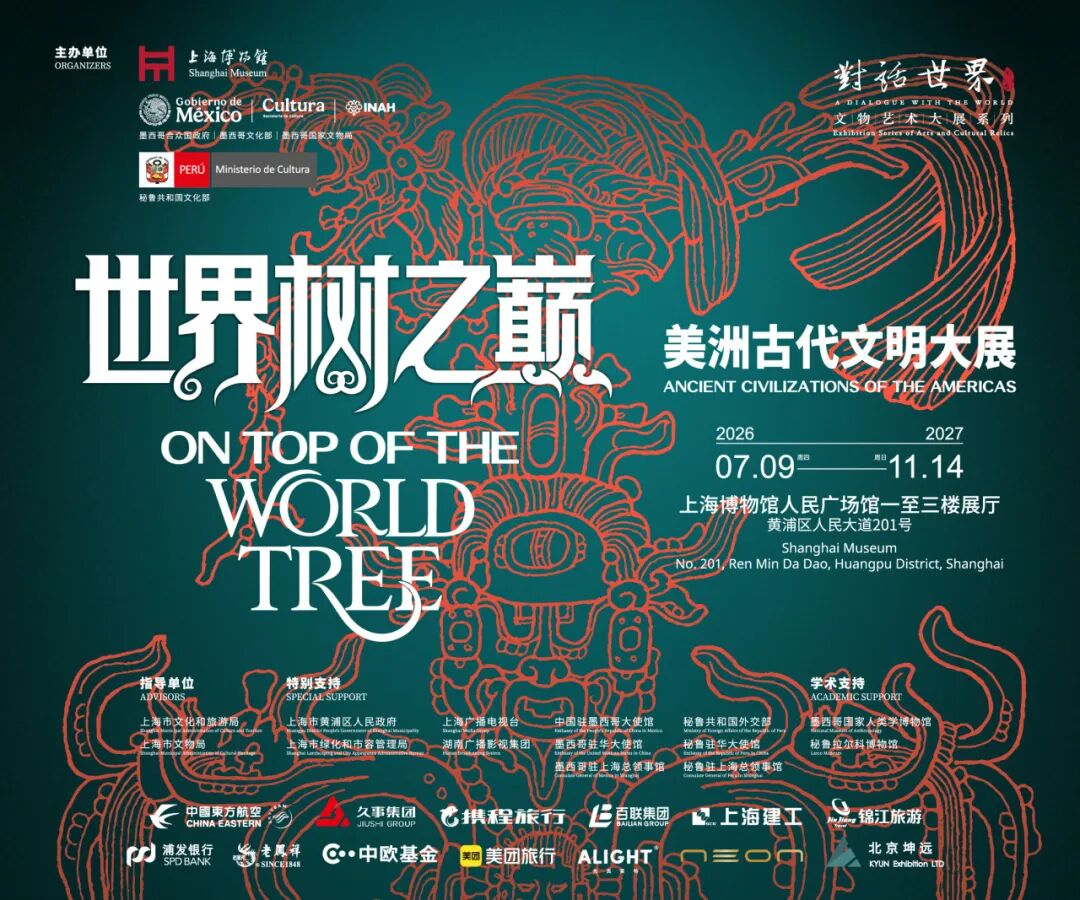
Exhibition Period: July 9, 2026 – November 14, 2027 (an extended 16-month run, Galleries 1–3, Shanghai Museum People’s Square Branch)
Organizers: Shanghai Museum, the Secretariat of Culture of Mexico and the National Institute of Anthropology and History of Mexico (INAH), and the Ministry of Culture of Peru. It is the sixth major exhibition in Shanghai Museum’s Dialogue with the World series, following the blockbuster The Summit of the Pyramids: Exhibition of Ancient Egyptian Civilization.
Exhibit Scale: 1,129 sets, nearly 3,000 artefacts dating from 1200 BCE to the 16th century CE. The show covers ancient civilizations of Mesoamerica and the Andes including the Olmec, Teotihuacan, Maya, Aztec, Moche, Chimú and Inca. Cultural relics from museums across seven Chinese provinces are also on display, presented side-by-side with American antiquities for cross-civilization comparison. It is the largest and most comprehensively curated special exhibition on ancient American civilizations ever held in China, and ranks among the leading shows of its kind worldwide.
I. Two Main Sections and Highlight Artefacts
The exhibition is built around the core cosmological concept of the World Tree, central to ancient American belief systems: its roots reach down to the underworld, its trunk stands in the mortal realm, and its crown rises to the heavens. It acts as the cosmic axis connecting heaven, earth, life and death, and shapes the entire narrative of the exhibition.
Ground and First Floors: Sacred Cycles of Time and Space · Ancient Mesoamerican Civilizations (Mexico Gallery)This section presents more than 2,600 artefacts on loan from 13 Mexican cultural institutions. Many of these objects leave Mexican territory for the very first time.
Highlight Artefacts: The 4.5-tonne giant basalt colossal head No.4 of the Olmec culture, the iconic relic of the “mother civilization” of the Americas; the Maya stela from Calakmul; the Feathered Serpent sculpture from Teotihuacan; Aztec ritual objects, fragments of Maya codices, corn god ceramic figurines, and jaguar ritual jade artefacts.
Narrative: It interprets Mesoamerican beliefs in cosmic cycles, the transmigration of souls and the creation myth centred on maize, alongside the great intellectual achievements of the Maya including their calendar, vigesimal numeral system and the concept of zero.
Second Floor: Empire of Gold · Masterpieces from Machu Picchu (Peruvian Andean Gallery)This section features 325 collections from Peru’s Larco Museum, dominated by Andean gold and silver wares, painted pottery and textiles.
Highlight Artefacts: An Inca gold headdress, gold ear ornaments, painted anthropomorphic pottery vessels of the Moche culture, and fine Andean woven textiles. Andean civilizations did not develop writing; social order and spiritual beliefs were transmitted through artefacts and quipus (knotted recording cords).
Cross-Civilization Comparative Zone (running through all galleries)Jade objects, pottery and ritual bronzes from museums of seven Chinese provinces are displayed alongside American ritual artefacts. Comparisons are drawn between ancestor worship, cosmic worldviews, jade ritual systems, shamanism and agricultural creation myths. The curatorial approach does not seek to prove shared origins between the cultures. Instead, it illustrates how two independently developed civilizations arrived at parallel reflections on the cosmos, mortality and social order, enabling mutual learning between civilizations.
II. Integrated Citywide Companion Programme (Exhibition Plus)
Beyond the museum walls, the curatorial team designed a city-wide immersive experience themed around five interconnected elements: artefacts, people, animals, plants and food.
Chenshan Botanical Garden: A maize exhibition zone (maize formed the foundation of ancient American civilizations).
Shanghai Expo Culture Park: An agave display area.
Shanghai Zoo: A themed zone featuring scarlet macaws.
VR Immersive Projects: Flight over Machu Picchu and Maya Adventure. Additional offerings include museum night openings, a series of academic lectures and youth archaeology workshops.
Cultural and Creative Merchandise: Product lines themed on the maize god, jaguar and Maya calendar.
III. Mainstream Media Comments
Xinhuanet: In the past, public understanding of ancient American civilizations in China was mostly limited to sensational narratives such as the “Maya prophecy”. This major exhibition restores ancient American civilizations to their complete, independent cultural lineage. It clearly demonstrates that the Americas were one of the independent cradles of human civilization, boasting sophisticated writing systems, calendars, mathematics and urban state systems. The paired display of Chinese and American relics represents the exhibition’s greatest innovation: rather than simple analogies, it creates a space for two separate civilizations to gaze upon one another.
People’s Daily Online: This cross-continental relic exhibition spanning over 20,000 kilometres marks a milestone in China-Latin America cultural exchange. Unlike many overseas relic shows which merely “import exotic treasures”, this exhibition was co-curated by Chinese, Mexican and Peruvian scholars who jointly defined its narrative framework, embodying equal dialogue between civilizations.
The Paper: Shanghai Museum continues its ambitious Dialogue with the World series, shifting its focus from ancient Egypt to the Americas. The core challenge lies in dismantling the popular “mystique” surrounding ancient American cultures. Using the World Tree as a unifying narrative thread, the curatorial team weaves thousands of disparate artefacts into a cohesive story, lowering barriers to understanding for general visitors.

评论
共 0 条