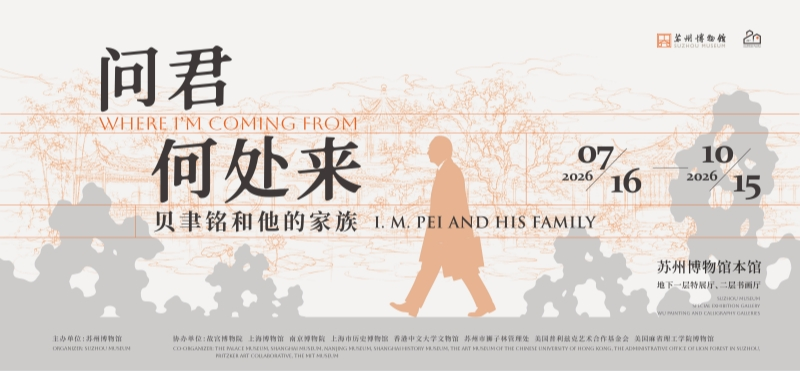
Exhibition Period: July 16 – October 15, 2026. Suzhou Museum Main Building (Special Exhibition Hall on B1 Floor and Calligraphy & Painting Hall on the 2nd Floor). Admission is free with advance reservation. This landmark special exhibition marks the 20th anniversary of the completion of the new Suzhou Museum building.
Its most distinctive feature: departing from narratives that celebrate I.M. Pei’s iconic architectural achievements such as the Louvre Pyramid, it takes the family’s literary heritage as the key to explore the spiritual origins that shaped the great architect.
I. Basic Exhibition Overview
Exhibition Title: Where Is I.M. Pei Coming From: I.M. Pei and His FamilyCore proposition: What made I.M. Pei who he was?Curatorial narrative thread: Origins and Homecoming, divided into five progressive sections: Family Lineage, Hometown Roots, Youth, Global Practice, and Black-and-White Dream.
Exhibit Scale: A total of 113 sets of precious cultural relics and archival materials.
Lending institutions: An impressive roster including the Palace Museum, Shanghai Museum, Nanjing Museum, Shanghai History Museum, the Administration of the Lion Grove Garden, the Pritzker Architecture Prize Foundation (USA), and the MIT Museum.
Types of exhibits: Genealogy manuscripts of the Pei clan, family paintings and calligraphy, porcelain of the Ming and Qing dynasties, ancient books and stone rubbings, early photographs of I.M. Pei, architectural manuscripts and design sketches.
Curatorial innovation: The entire Suzhou Museum itself functions as an exhibit. Beyond the galleries, twelve spatial nodes are set up in the museum’s gardens and corridors to display videos and sketches from I.M. Pei’s design process for Suzhou Museum. Visitors view the exhibition inside a building designed by Pei himself, creating a triple intertextuality of “exhibition — architecture — the city of Suzhou”. Visitors may also extend their visit to the Lion Grove Garden on-site to complete this journey of tracing roots.
II. Core Content of the Five Sections
Family Lineage: The 500-year genealogy of the Wu Zhong Pei clan. The Pei ancestors moved from Lanxi in Zhejiang to outside Changmen Gate in Suzhou in the mid-Ming Dynasty. They first practiced medicine and later engaged in business. During the Qianlong reign of the Qing Dynasty, the family became one of Suzhou’s “Four Wealthy Clans”. Key exhibits include the handwritten Genealogy of the Wu Zhong Pei Clan, paired with a celadon medicine bottle from the Qing Dynasty and the fan painting Spring Scenery of the Jiangnan Region by Pei Dian, an ancestor of the Pei family.
Curatorial interpretation: The Pei family was far more than a wealthy aristocratic clan. Generations of its members upheld literary pursuits and collected paintings and calligraphy. The family education cultivated I.M. Pei’s aesthetic temperament of “propriety and self-possession”, and this latent cultural gene profoundly shaped his architectural philosophy.
Hometown Roots: Suzhou Gardens and Childhood Memories. This section focuses on I.M. Pei’s youth spent in the Lion Grove Garden. Among rockeries, winding paths and lattice windows, he experienced the spatial philosophy of gardens where scenery shifts with every step. Exhibits include ancient paintings such as The Lion Grove Garden, illustrating how Jiangnan gardens planted the seed of Eastern spatial design in his mind.
I.M. Pei once stated: “I do not deliberately adopt a Chinese style in my designs, but Chinese poetry, painting and gardens are the source of my inspiration.”
Youth: Student Years in Shanghai. It depicts the collision between Chinese and Western cultures in modern Shanghai. It was here that Pei encountered modern architecture and nurtured the ambition to pursue further studies in the United States. Old photographs and Republican-era publications recreate the historical context.
Global Practice: Architectural Projects Worldwide. Instead of displaying piles of architectural models, the section features carefully selected manuscripts and archives. It presents Pei’s modernist architectural training in the United States and his projects across the globe, as he continuously sought balance between East and West.
Black-and-White Dream: The new Suzhou Museum, I.M. Pei’s final masterpiece. As the climax of the exhibition, this part showcases manuscripts and videos documenting the whole process of the museum’s design, revisions and construction. The building’s palette of black, white and grey echoes the whitewashed walls and black tiles of Jiangnan architecture — the master’s ultimate response to his homeland in his later years.
III. Media and Academic Reviews
Xinhua Daily: Previous exhibitions about I.M. Pei mostly focused on his architectural works and technical achievements. This show reverses that perspective. Rather than glorifying architectural marvels like the Pyramid, it seeks to explore “the spiritual origins of the master”. It tells visitors that Pei’s Eastern aesthetic was not superficial decorative symbolism; it was rooted in 500 years of family literary heritage and immersion in Jiangnan gardens, internalized within his spatial logic. This curatorial approach sets a new paradigm for biographical exhibitions in China: shifting from “worship of achievements” to humanistic narratives that trace origins.
Ziniu News: The most touching aspect of the exhibition is that it dismantles the myth of the “genius architect”. I.M. Pei was not born a great master. He was shaped collectively by centuries of family culture, the civilization of the Jiangnan cities, and cross-era education. Holding the exhibition inside a building he designed creates a powerful dialogue: the architecture is both the vessel holding exhibits and the subject of the narrative.
Fine Arts Newspaper: Every exhibit serves as “a clue leading to I.M. Pei”, rather than isolated national treasures. Ancient paintings by Ni Zan, family fan paintings and Pei’s manuscripts echo one another, piecing together a complete spiritual map and connecting the intrinsic links between classical Chinese cultural heritage and modern architecture.
IV. Supporting Exhibition Programmes
Cultural and Creative Merchandise: Geometric origami guidebooks. Visitors fold the paper by hand to intuitively understand I.M. Pei’s geometric architectural aesthetics.
Academic Events: A series of lectures, member-led guided tours and study programmes. A companion catalogue bearing the same title Where Is I.M. Pei Coming From: I.M. Pei and His Family has been published.

评论
共 0 条