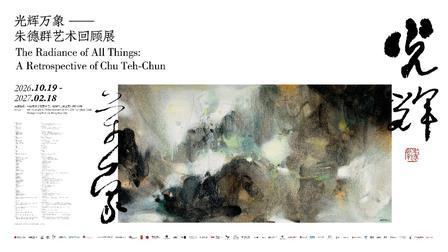
Radiant Visions — Chu Teh-Chun Retrospective
Setting off from the shores of West Lake, we embark on a symphony of light across mountains and seas.
Radiant Visions — Chu Teh-Chun Retrospective gathers more than 260 oil paintings, ink works, manuscripts and precious archival documents. Following the trajectory of his creative journey, the exhibition traces his long artistic pilgrimage: from youthful art training, his transformative years in Paris, to the pinnacle of his late career.
Light and shadow permeate all things; heaven and earth nourish all life. Entering the gallery, amid layered hues and surging brushstrokes, one may grasp the life of an artist who bridged East and West and meditated upon the cosmos.
📍Venue: Art Museum of China Academy of Art (Nanshan Road, Hangzhou) ⏰Duration: 19 Oct 2026 — 18 Feb 2027 Organisers: China Federation of Literary and Art Circles, Publicity Department of Zhejiang Provincial Party Committee, Hangzhou Municipal People’s Government Co-organisers: China Artists Association, China Academy of Art Scale: Over 260 works and archival items in total, including 107 oil paintings; 57 works by Chu Teh-Chun plus one sculpture by Félix Rougier donated by his family. Accompanying Academic Event: Symposium From Hangzhou to Paris — The Artistic World of Chu Teh-Chun
Foreword
Chu Teh-Chun (1920–2014), distinguished alumnus of the China Academy of Art and French-Chinese artist, became the first Chinese academician of the Académie des Beaux-Arts of the Institut de France in its 200-year history. Together with Wu Guanzhong and Zao Wou-Ki, he is known as one of the “Three Musketeers of Chinese Artists in France”. He enrolled at the National Hangzhou Art Academy in 1935, nurtured by Lin Fengmian, Wu Dayu and Pan Tianshou. In 1955 he travelled to Paris, shifting from figurative painting to lyrical abstraction. Drawing on the light, colour and brushwork of Western oil painting, he embodied the artistic conception of Chinese landscape painting and the philosophy of The Book of Changes, reviving the spirit of Chinese freehand brushwork within modern abstract painting. He stands as one of the most pivotal figures for the mutual exchange of Eastern and Western art in the 20th century. As a key academic project marking the centenary of the China Academy of Art, this exhibition traces his journey from West Lake to the global stage and unfolds his lifelong artistic pursuit across six sections.
Section I · Original Aspiration by the Lake and Hills
West Lake is the spiritual origin of Chu Teh-Chun’s art. Here he received an education rooted in “reconciling Eastern and Western art”, studying both Western modelling and Chinese ink brushwork. Early sketches, portraits, drawings and school archives are brought together. Though still immersed in realist practice in this period, he already developed a keen sensitivity to the vitality of nature and flowing light. He departed for Paris in 1955, yet the misty aura of West Lake’s landscapes would permeate every subsequent work he created.
Section II · Diffused Aura of Nature
After arriving in Paris and inspired by Nicolas de Staël, Chu Teh-Chun gradually shed figurative outlines and turned toward abstraction. No longer depicting rocks, mountains or woods, he captured the flowing breath of nature within clouds, wind, rain and dawn or dusk. His imagery shifted from defined forms to veils of colour and lines. This marked the formative phase of his abstract language: colours are gentle, brushwork restrained, infused with the poetic mood of Song-dynasty landscape painting.
Section III · Aura of Light and Hue
“Light” lies at the heart of Chu Teh-Chun’s art. He once described himself as “a worker beneath the sun”. In this phase, light takes centre stage in his canvases — flowing, shimmering, diffusing, as if celestial light streaming through clouds. His colour layers are rich and translucent, compositions free and expansive. He transforms natural light into an inner spiritual source within the painting, crafting ethereal, vast and dreamlike lyrical space. His magnum opus Aura of Renaissance is a centrepiece in this section, a monumental work dedicated to his motherland.
Section IV · Heaven and Earth, All Things Ripening
In his later years, Chu Teh-Chun grounded his practice in the line from The Book of Changes: Heaven and Earth interpenetrate in vital qi, and all things ripen. Yin and yang interact, the void and the substantial resonate. His colours grow bolder and more exuberant, brushstrokes surging and spiralling. The canvas is no longer a quiet landscape, but a grand symphony of cosmic vitality and coexistence of all beings — fervent, abundant and brimming with life force, reaching the apex of his artistic vision.
Section V · Companions Across a Century
This section focuses on artistic friendships and archival materials. On view are letters, photographs, exchanged artworks and manuscripts between Chu Teh-Chun and his mentors and peers: Lin Fengmian, Wu Dayu, Wu Guanzhong, Zao Wou-Ki and others. It recalls the ideals of that generation: amid the turbulent 20th century, these artists who emerged from the Hangzhou Art Academy each pursued the fusion of East and West along distinct paths, reflecting upon and supporting one another.
Section VI · Stream of Life
This section brings together his late ink paintings, calligraphy, ceramic works, sketches and notes. Beyond oil painting, the linear power of calligraphy nourishes his canvases in return; ink freehand art and oil abstraction spring from the same source. This part showcases his cross-media creations: brush and ink are the pulse of emotion, lines the surging current of life — the final reverberation of his artistic life.
Epilogue
From West Lake to Paris, from realist portraiture to cosmic symphonies, Chu Teh-Chun never severed East from West, tradition from modernity. He proved that the Chinese artistic concept of qi yun (vital resonance) can become visual poetry for all humanity, expressed through modern abstract painting.

评论
共 0 条